Building a living frontier where a small crew can find a home, make a name, and venture into the inexplicable.
FALLOW is a grounded, expedition-first survival and tactical simulation in development. These are the records of how it is taking shape—from the systems that work to the ideas that don't survive playtesting.
// FIELD RECORD Development details are drawn from completed workstream reports and playtests. Screenshots show real game builds; the survey illustration above is an editorial motif, not in-game map data. The FALLOW title and world are still in development.
We wanted a fireteam that could look after itself. Playtesting revealed which parts actually helped—and which new interface we'd rather leave behind.
There's a particular kind of frustration in a tactical game: watching someone stand beside a wounded teammate while you pause the world and tell them to help. FALLOW's latest workstream explored how much of that responsibility should belong to the survivors themselves.
The ambition was bounded initiative—not a squad that decides your strategy for you, but people capable of handling immediate, sensible actions within their orders.
What made it into the game
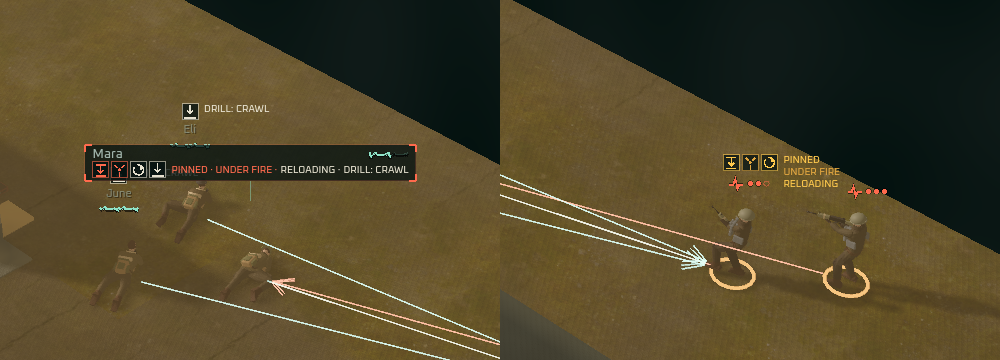
Casualty aid. A survivor can drag a downed teammate a few metres into cover, then stabilise them if they have a medkit.
Mutual support. Covering fire can protect a teammate moving under fire. A shooter can take over a reloading ally's target.
Reorganisation. A new Reorg order gathers and stabilises casualties, watches the last known threat, and redistributes ammunition from fallen teammates.
Small human moments. Brief barks—"covering Mara!" or "reloading"—appear in the log and in the world near the person speaking.
CAPTURE / 01 The same readable state language now gives friends and foes distinct visual treatment.
The feature that didn't earn its place
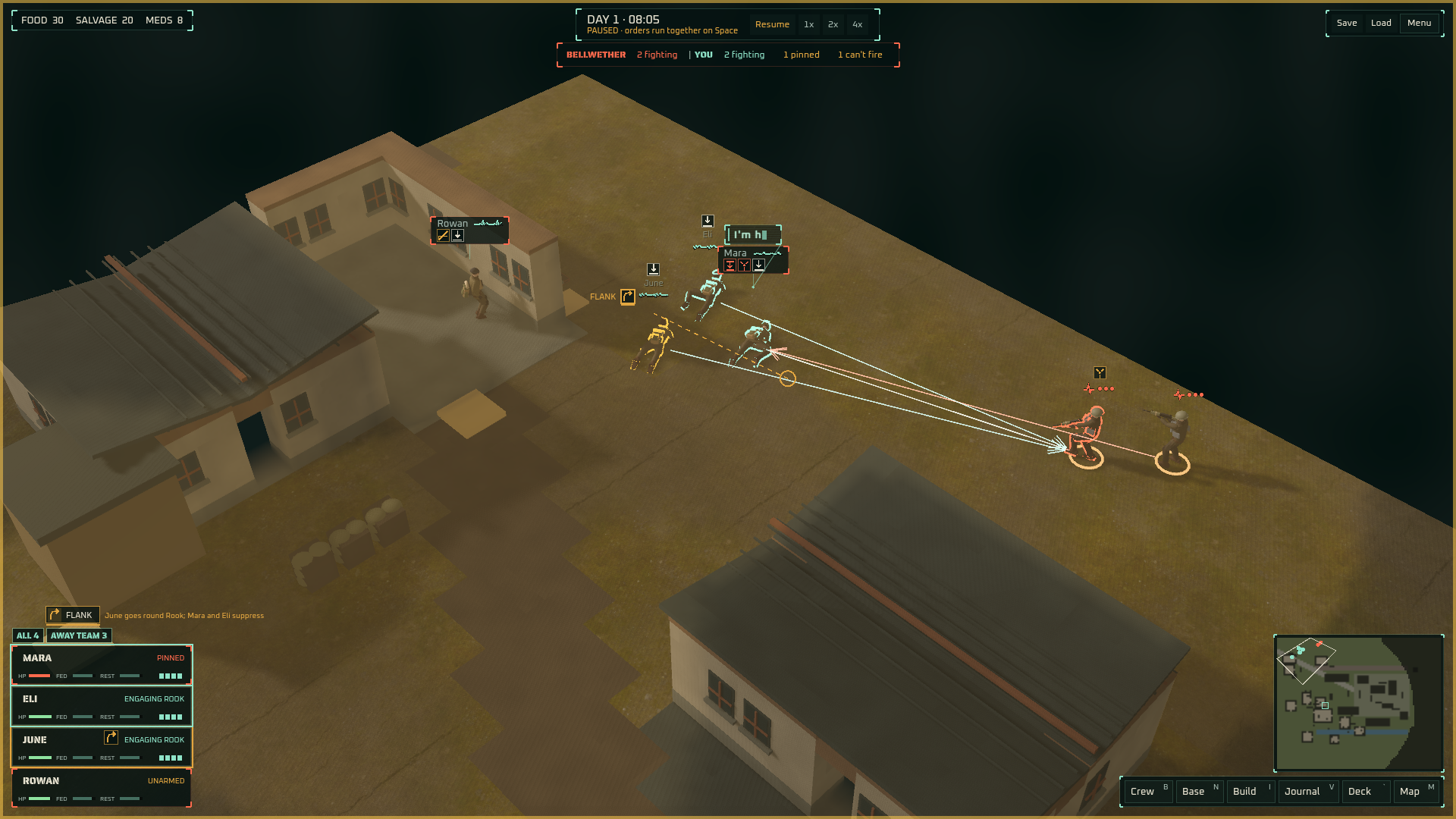
We also built a system where a fireteam could propose requests—retreating, flanking, dragging a casualty—and wait for you to accept them. The benchmarks exposed problems: a lone flanker entered crossfire; an untimely pursuit left other enemies still shooting.
CAPTURE / 02 An experimental flank request during testing. This request interface was removed after the playtest; the image is a record of the experiment, not a current feature.
“I didn't use it at all and didn't feel like I wanted to.”
That was the playtest verdict on the request interface. So we retired those badges and benched the INITIATIVE setting for now, keeping both tested for a possible revisit. The immediate helpful behaviours stayed. This is exactly why a workstream doesn't end when the code runs: it ends when the interaction earns its place.
The interface gets a name
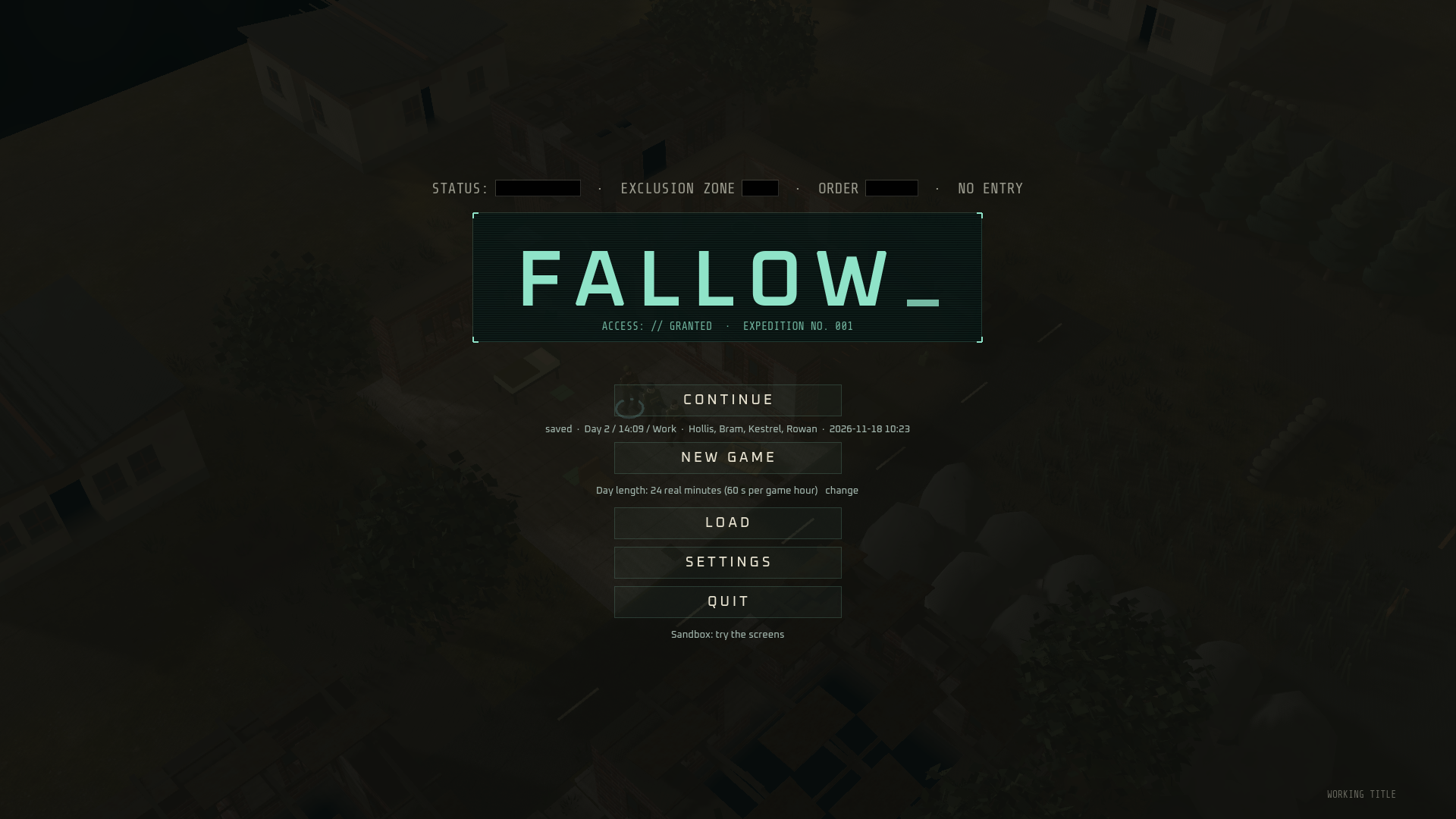
The same branch brought a significant identity change: Fallow became the game's working title. The start screen was redesigned around a redacted order, a stark FALLOW readout, and a brief expedition designation. The field interface also settled on Oxanium for ordinary text, with Saira Stencil One retained for titles and names.
CAPTURE / 03 The working title appears in the game itself, with the restrained command-interface palette carried through.
What the tests said
Quick checks passed 16/16 after each step. On the final game code, 27 of 28 Full suites passed; the native walkthrough initially failed, partly because improved covering fire prevented the scripted casualty. After adjusting that script, its own validator passed 14/14, but the other 27 suites were not rerun in that same pass.
THE HONEST RECORD // Some ideas remain deferred: the order-request system, an intermittent slow squad move that wasn't reproduced, and several home-base improvements. Those limits belong alongside the successes.
The next substantial stretch of development turns toward enemies and detection, the home base, and eventually a convincing complete demo on Westbank.
Target lines, a clearer fight summary, state icons and credible engagement decisions.
ARCHIVE SUMMARY
WS 03
16 NOV 2026
Movement with purpose
Formation marching, multi-step plans, contact drills and building occupation.
ARCHIVE SUMMARY
WS 02
15 NOV 2026
The command layer
Teal world-space tags, right-click actions, context and a more legible interface.
ARCHIVE SUMMARY
02 / Creative foundation
THE WORLD DOESN'T WAIT TO BE SAVED.
Somewhere between recovery and emergence, people have made a life in the shadow of the place where everything began.
The Fallow
The Fallow is a named region, not a generic class of zones. It was ground zero of the Collapse, the disaster that spread outward and changed the world. Roughly thirty to sixty years later, its consequences are still unfolding.
Beyond it, communities have rebuilt. Inside it, industrial ruins, farms, towns, wilderness and reclaimed infrastructure form a continuous frontier. The cause of the Collapse remains unresolved; so does the nature of the artifacts.
People who belong out there
Many people enter the Fallow. Fewer learn how to live and work there. Expeditionaries survey, recover, escort, hunt artifacts, take contracts, and cull the nonhuman threats that endanger settlements. Their work is varied, their reputations complicated, and no single organisation gets to decide who counts.
A place to come home to
The player's refuge can grow into a functioning expeditionary headquarters and, potentially, a town. It needs food, production, repair, trade and people with reasons to stay. Home matters because it gives every journey into the Fallow a human consequence.
Beyond horror
The frontier can be frightening, but it can also be beautiful, strange, funny and quietly domestic. Altered wildlife, unfamiliar species, ordinary life and inexplicable things coexist. The mystery is not a checklist waiting for a final answer.
CREATIVE STATUS // These are selected foundations agreed on 18 November 2026. The precise cause of the Collapse, the origins of artifacts, invented settlements and a universal expeditionary code are not established canon.
03 / The project
A WORLD IN PROGRESS.
An honest development journal for FALLOW: a grounded, expedition-first survival and tactical simulation built in Godot.
Why the journal exists
FALLOW's development is iterative and openly examined. Each completed workstream leaves behind a technical record, screenshots, playtest results and decisions. The Field Notes turn that evidence into a readable story about the emerging game.
These notes distinguish confirmed features from experiments, record what testing did and didn't prove, and leave mysteries in the world genuinely unresolved.
How publication works
After a workstream has been completed and merged, the project owner asks for a new Field Note. The editor reviews the private development diary and verified game evidence, writes the public-facing report, checks the screenshots and publishing status, then updates this site and its RSS feed.
Publication is deliberately owner-triggered rather than automatic on every code change. The game repository and detailed development diary remain private. No Claude calls are used to write or publish this journal.